

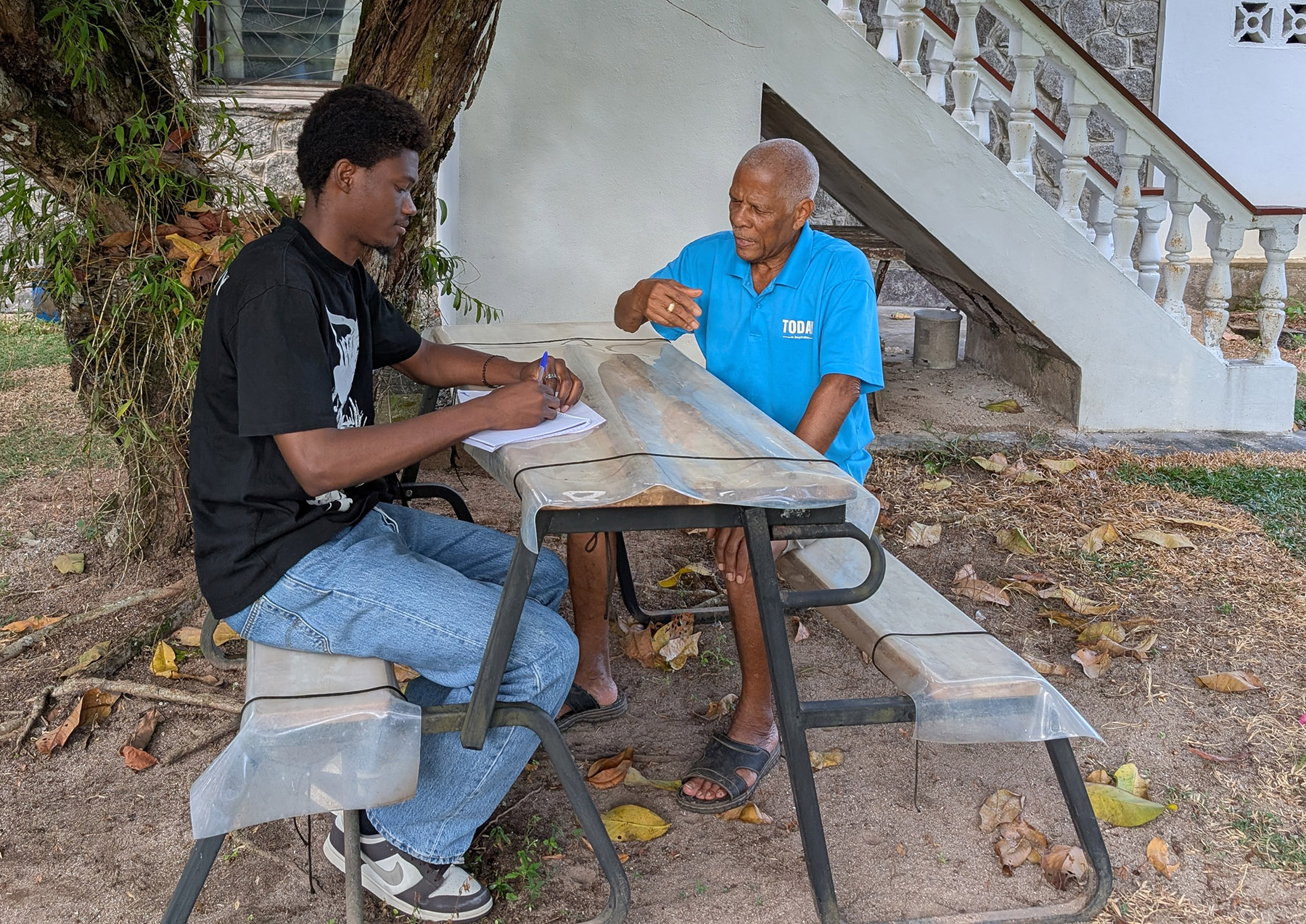
 The Agriculture Department recently welcomed Sena Alban SOEDJI, a 26-year-old researcher from Togo, West Africa, who is undertaking a one-and-a-half-month research mission in Seychelles on the potential for a Geographical Indication (GI) for Seychelles honey.
Sena is currently pursuing a Master’s Degree in Social Economics and Solidarity at the University of Rennes in France while completing an internship in La Réunion. He also holds a Master’s Degree in Agro-economics, with a specialization in value chain analysis and producer organization support.
His research aims to assess how stakeholders within the beekeeping sector can work together to successfully establish a Geographical Indication for Seychelles honey. Although his knowledge of beekeeping is mainly theoretical, the mission has allowed him to gain valuable practical insights into the local industry.
During his stay, Sena met with key stakeholders, including the Principal Secretary of the Agriculture Department, the Seychelles Bureau of Standards (SBS), the Trade Division, the Enterprise Seychelles Agency (ESA), and the Seychelles Beekeepers Association. These discussions focused on understanding the legal framework, quality standards, innovation support, and the coordination required to successfully implement a GI for local honey.
According to Sena, one of the most encouraging findings was learning about the existing GI sub-committee dedicated to Seychelles honey, which demonstrates the country’s commitment to developing the initiative through collaboration.
Visits to local apiaries also provided valuable insight into the realities of beekeeping in Seychelles. Sena observed a wide range of experience among beekeepers, from newcomers to highly experienced producers, each applying different techniques to improve honey production.
However, the study also highlighted several challenges facing the sector. High investment costs, limited access to equipment, and insufficient technical training continue to hinder the growth of commercial beekeeping. In addition, many beekeepers currently view the activity as a hobby rather than a business opportunity, often maintaining only one or two hives for personal honey production.
“My main focus is to understand how stakeholders across the beekeeping sector can coordinate effectively to make the future GI initiative for Seychelles honey successful,” Sena explained. “A Geographical Indication depends on strong collaboration and collective action among all stakeholders.”
His study builds on previous research conducted by CIRAD in 2024, which identified Seychelles honey as a suitable product for a GI, and the 2025 AFRIPI programme, which provided training and awareness on Geographical Indications.
Upon completing his research, Sena will provide a socio-economic analysis of the sector, helping stakeholders better understand their respective needs, expectations, and roles. The findings are expected to contribute to adding value to Seychelles honey, strengthening its identity, and promoting the unique connection between the product and the Seychelles environment.